
Beyond ESG
We are fighting a losing battle. The real issue of survival is here and now

Welcome to the +100 new subscribers who have joined us this week. If you’re reading this but haven’t subscribed, join our responsible investing community of +500 curious, smart & pragmatic investors 👇
The worst drought in 500 years hits Europe, blistering heat bakes more than 43% of US states, 22 million people in the Horn of Africa slip into the risk of starvation, while low rainfall in rice powerhouses China and India clouds the yield of the food staple.
The onset of the global pandemic and war has exacerbated a series of existential challenges that can not be reversed by screaming ESG. Supply chain strains, flood, drought, food scarcity - these events are pushing food prices up as war in one of the six breadbasket regions is tilting global food security into a state of high risk.
Beyond ESG lies the formidable reality of survival. As a world, we are facing an existential crisis.
IGNORING THE GLOBAL CRISES IS EXPENSIVE
Wildfires, crop shortages, and energy restrictions pressure governments and people worldwide.
What happens in our world will make your stomach churn and your wallet cringe.
Pakistan
A third of the country is underwater. Crops washed away. Some 33 million people are homeless. Billions of dollars of damage. A looming food crisis. And still, the unprecedented rains come. Pakistan’s mega-monsoon dumped up to 700% of the usual August rainfall on parts of the country, with floodwaters boosted by glacial melting from the enormous heat wave that hit the country in March.1 Pakistan has emitted less than 1% of the world’s greenhouse gases—but is already among the hardest-hit nations.
The United States
The western United States is, famously, in the grips of its worst megadrought in a millennium. The Colorado River, which supplies water to more than 40 million Americans and supports food production for the rest of the country, is in imminent peril. The levels in the nation’s largest freshwater reservoir2, Lake Mead, behind the Hoover Dam and a fulcrum of the Colorado River basin, have dropped to around 25% of capacity. Northern Mexico’s water crisis is spilling into Texas, drying out the two binational reservoirs of the Rio Grande, on which millions of people and a billion dollars in agriculture rely.
One reservoir, Lake Falcon, is just 9% full. Nearby communities scramble to extend water intakes and install auxiliary pumps to capture its final dregs. The other reservoir, Amistad, is less than one-third full.
Argentina
South American countries are hit by what is on track to be the worst drought in 12 years. Bangladesh depends on the Latin American country mainly for soybean and wheat.
China
China, a major rice producer, now faces a severe drought and record-breaking heatwave. Chinese authorities are attempting to induce rainfall in parts of central and southwest China.
Bangladesh
The country regularly imports cotton from the US and Brazil. Some 229 million acres of crops in the US are affected by drought. According to the UN, the US economy has lost an estimated £249 million due to drought and related crop failures.
Bangladesh is now trying to import rice from India. But low rainfall in India's several states hampers paddy planting. Importers said if the neighboring country bans rice export in the upcoming months to feed its people, Bangladesh will be in trouble.
Germany
The Rhine river has reached such low levels that boats are forced to reduce their cargo load by up to 75% and even cancel their transport. This is a huge issue as the Rhine is a major transport route in Germany.
Italy
The flow of the river Po has fallen by 90%, hitting corn and risotto rice production. The Po is at the highest level of drought severity, with saltwater moving record distances inland from the Po Delta as the river level drops.
The risotto rice harvest could be down by 60%, with rice fields damaged for many years to come by the increased levels of salt. Rising temperatures and dry conditions also paved the way for the worst locust outbreak in three decades, which decimated winter food supplies for livestock on the island of Sardinia. In total, a third of farms in Italy are now producing food at a loss.
Food Scarcity
I’m shocked it’s as bad as it is - A Minnesota farmer
The US Farm Belt is struggling with areas of heavy drought west of the Mississippi River. Food scarcity and drought are interconnected.
With Europe hurt by heat waves and Argentina planting likely delayed by drought, the size of North America’s crops will determine global supplies well into next year. In a year plagued with runaway inflation, high volatility, and food shortages, farmers are facing immense pressure.
“There’s been so much heat and extremes this growing season; I don’t think the story is over about potential yield declines,” Kevin McNew, chief economist at agriculture-technology firm Farmers Business Network.
Drought is the great enemy of human civilization, depriving people of the two essentials of life – food and water. When the rains stop and the soil dries up, cities can die, and civilizations collapse as people abandon lands that cannot sustain them. Drought has been identified as the primary or significant contributing factor in the collapse of a surprising number of great civilizations in the past.
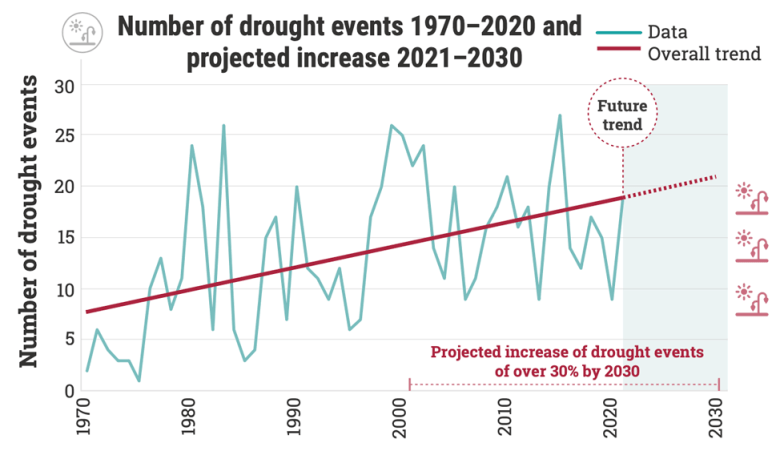
Source*3
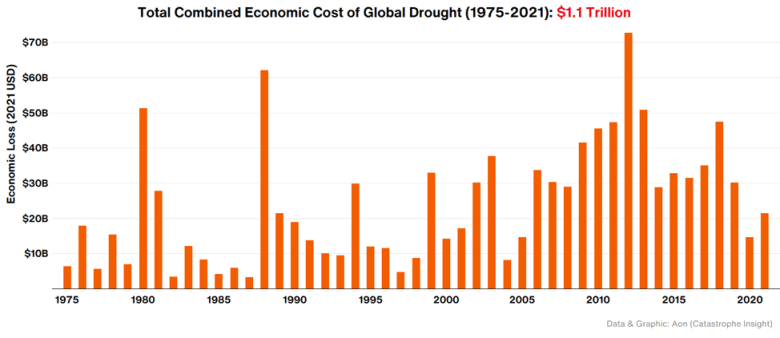
According to the American Meteorological Society’s State of the Climate in 2021 report, a sharp increase in global drought area began in mid-2019, reaching a peak in August 2021, with 32% of global land area experiencing moderate or worse drought and declining slightly thereafter. This peak beat the previous record of 31.6% of the global land area in drought, set in November 2002. Global drought coverage has likely remained at near-record levels in 2022, though the statistics will not be updated until the year is complete, said drought researcher Jonathan Barichivich in an email.
The Horn of Africa (Drought)
Years of insufficient rainfall across Kenya, Somalia, and Ethiopia have caused the worst drought in 40 years and conditions akin to famine in the hardest-hit areas. The number of people at risk of starvation in the drought-ravaged Horn of Africa has increased to 22 million.
An unprecedented four failed rainy seasons have killed millions of livestock, destroyed crops, and forced 1.1 million people from their homes in search of food and water.
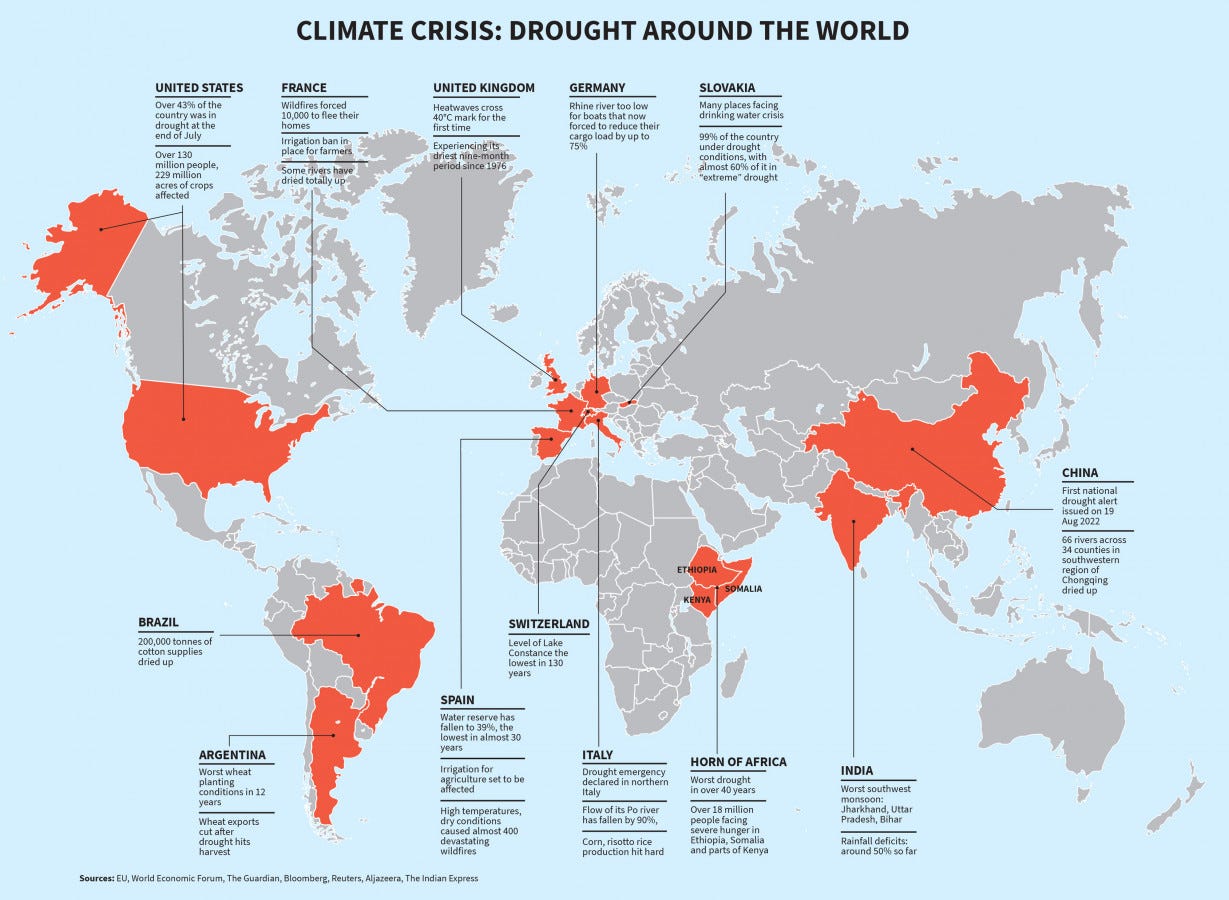
Source:TBS News
Are We Anti-ESG?
There have been only a handful of times in modern history when violence, crises, or mass social movements have confronted the world so that swaths of people have suddenly become fixated on a singular, existential issue.
While all 165 nations party to the UN’s Framework Convention on Climate Change agree that climate chaos is happening, there is no agreement on who should pay for it. The question of who pays caused a major debate between industrialized and developing nations, which also disagreed over how strongly to criticize the failure of rich countries to deliver a promised A$145 billion (the equivalent of nearly $100 billion) annually in climate finance by 2020.
Failed Talk
The recent G20 talks in Bali failed for the same reason. Energy and climate ministers from some of the world’s largest economies have failed to agree on joint texts at G20 meetings in Bali, Indonesia. With two months to the Cop27 summit, host Egypt has warned against “backtracking” on climate commitments.
The report, issued by the Intergovernmental Panel on Climate Change, a group of scientists convened by the United Nations to guide world leaders, describes a world of worsening food shortages and wildfires and a mass die-off of coral reefs as soon as 2040 — a period well within the lifetime of much of the global population.
Our Future is Bleak
Places like California in the US have suffered from droughts for years, with statewide restrictions on water use becoming the norm. But record droughts in other areas, like Europe and Asia, affect everything from agriculture to energy transport. Many places now suffering from severe heat and drought — like the UK — don’t necessarily have the infrastructure to deal with such weather extremes. And when rain does eventually fall, it’s likely to cause flooding due to sustained heat and dryness.
As Vox’s Benji Jones wrote, agriculture in parts of California and Arizona is suffering due to drought in the Colorado River and low water levels in two reservoirs, Lake Powell and Lake Mead. Farmers are the primary users of water from the Colorado River, and while some have already cut their supply, the drought isn’t likely to subside any time soon — meaning that future cuts will be necessary. That will be a problem for many Americans already reeling from high food prices due to inflation, Jones wrote:
When farmers use less water, they tend to produce less food. And that could cause food prices to go up, even more than they already have. Winter veggies, like lettuce and broccoli, could take a big hit, as could Arizona’s delectable wheat. More concerning still is that the shrinking Colorado River is just one of many climate-related disasters that are threatening the supply and affordability of food.
Why Must We Care?
Socialism, or capitalism, we all need to take action; else, we perish.
Supply Chain Will Get Worse & Your EVs Won’t Have Power
Vera Wang, a Chengdu resident, said that just to charge her electric car, her boyfriend waited in a long line overnight at a charging station that was only partly operating. It was 4 a.m. when he reached the front of the line.4
Car assembly plants and electronics factories in southwestern China have closed for lack of power. Owners of electric cars are waiting overnight at charging stations to recharge their vehicles. Rivers are so low there that ships can no longer carry supplies.
The drought has dried up dozens of rivers and reservoirs in the region and cut Sichuan’s hydropower generation capacity by half, hurting industrial production.
A record-setting drought and an 11-week heat wave are causing broad disruption in a region that depends on dams for more than three-quarters of its electricity generation.
Our obsession with the EV future has blinded us from the real challenges.
- Foxconn, the giant Taiwanese electronics manufacturer, and CATL, the world’s largest maker of electric car batteries, have both curtailed production at factories in the vicinity.
- Volkswagen closed its 6,000-employee factory in Chengdu for the past week and a half, and Toyota temporarily suspended operations at its assembly plant.
- Californian residents are asked not to charge their electric vehicles during peak hours to help conserve electricity - an oxymoronic statement from Californian Governor. Since September 2020, Governor Gavin Newsom has pushed for the state to adopt a new policy eliminating the sale of new gas-powered vehicles by 2035 to help meet 2045 zero-carbon climate goals. At the same time, the power supply in California has been in a state of constant flux due to the same 2045 policy removing oil, gas, and coal plants at a rate faster than wind, solar, hydro, and other renewable sources of energy can replace them.
Inflation Will Become Permanent
A cotton crisis is looming. Severe climate events and political tensions have disrupted the world’s top-five cotton-producing countries, spelling trouble for downstream businesses globally, including apparel, homewares, and even medical supplies. The south Asian nation is the fifth largest producer and contributes roughly 6% of the global cotton supply. Your basic cotton t-shirt just got very expensive.
Investment Opportunities
Our priorities are misaligned.
The world needs to act now to protect the most vulnerable communities from the threat of widespread famine in the Horn of Africa. According to WFP Director David Beasley, there is still no end to this drought crisis, so we must get the resources needed to save lives and stop people from plunging into catastrophic levels of hunger and starvation.
We need to invest in infrastructure.
We need to shift our focus from investing blindly in ESG companies; instead, we should direct investments in technologies and companies striving to address the water crisis and food scarcity.
We need to invest in creating manufacturing facilities in the United States to shield our economy when a war erupts between China and Taiwan.
We must direct our investments toward vertical farming, advanced irrigation systems (NYSE: LNN and VMI), responsible mining companies, and water waste treatment facilities (NYSE: OTTR and AWK).
Conclusion
Solutions will not be easy to sort out since the dramatic food price escalation has numerous causes. Skyrocketing oil prices have strained every stage of food production, from fertilizer to tractors to transport. Eliminating hunger and malnutrition and achieving wider global food security are among humanity’s most intractable problems. Higher food prices have not helped, but price levels are not the fundamental problem. High prices impose undeniable hardship on the poorest consumers, including many subsistence farmers whose production is insufficient to meet their consumption needs. Yet the persistence of global hunger–the chief manifestation of food insecurity–is a chronic problem that predates the current period of higher food prices.
As we march together towards the inevitable extinction, we are determined to reverse our misdeeds. We need to ask ourselves: Are we determined to reverse our misdeeds?
Weigh in your thoughts 👇
https://www.fastcompany.com/90788038/amid-floods-pakistan-calls-for-rich-countries-to-pay-for-climate-damage-will-they-ever
https://www.propublica.org/article/colorado-river-water-shortage-jay-famiglietti
The number of droughts globally since 1970 has been increasing, according to the international disaster database, EM-DAT. Its database includes all disasters that kill at least 10 people, and/or affect 100 or more people, and/or result in a call for international assistance or declaration of a state of emergency. (Image credit: United Nations, 2022, Global Assessment Report on Disaster Risk Reduction – Our World at Risk: Transforming Governance for a Resilient Future
https://www.nytimes.com/2022/08/26/business/economy/china-drought-economy-climate.html